How AI Search Engines Decide Which Brands to Recommend
A client called me last week, a bit confused. He had done everything his previous marketing person told him. Website was there, Google Business Profile was updated, even a few blog posts on the site. But when he asked ChatGPT “best furniture shop in Malappuram”, his shop did not come up. Two competitors did.
This is becoming a very common question now. Not “why am I not ranking on Google”, but “why is AI not recommending my brand”. And honestly, these are two different games, even though they look similar from outside.
Search Engines and AI Engines Are Not the Same Thing Anymore
For years, ranking meant one thing. Get your website to show up on the first page of Google. You optimised keywords, built backlinks, kept your site fast, and if you did it right, you showed up.
Now there is a second layer running alongside this. Tools like ChatGPT, Google AI Overviews, Perplexity, and voice assistants do not just list ten blue links. They read through information, pick what they think is the best answer, and present it directly, sometimes without the user ever clicking a website at all.
This means your business is not just competing for a spot on a results page anymore. It is competing to be the answer itself. And that is a very different battle.
So How Does an AI Engine Actually Pick a Brand
I have spent a good amount of time testing this with different client businesses, and a pattern keeps repeating.
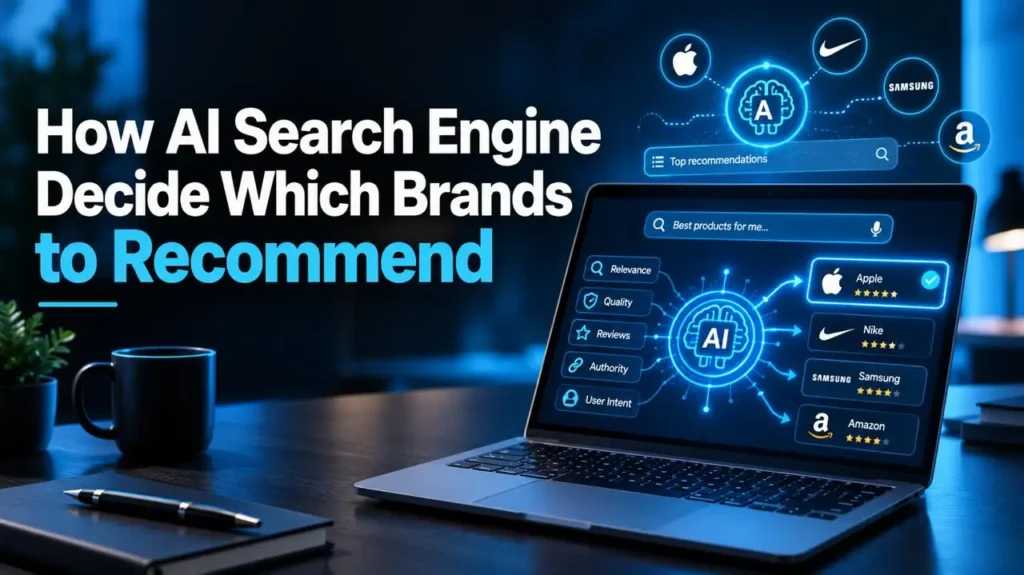
First, these AI tools pull heavily from content that clearly and directly answers a question. Not vague marketing language, but actual, specific information. If someone asks “which digital marketing expert in Malappuram handles small business SEO”, the AI is scanning for content that answers exactly that, in plain words, not buried under fancy taglines.
Second, consistency across the internet matters a lot more than people realise. If your business name, services, and location are mentioned the same way across your website, Google Business Profile, directories, and social media, AI tools trust that information more. If one place says you are a “digital marketing agency” and another calls you a “web design freelancer”, the AI gets confused about what you actually do.
Third, reviews and mentions from other sources carry real weight. AI engines are not just reading your own website, they are reading what other people and other websites say about you. A local business directory mentioning your name, a genuine Google review describing what you did well, even a mention in someone else’s blog post, all of this builds what these systems treat as trust signals.
Fourth, structured and clearly organised content performs better. Content with clear headings, direct questions and answers, and simple explanations tends to get pulled into AI answers more often than long, unstructured paragraphs that bury the actual point somewhere in the middle.
Why This Matters More for Small and Local Businesses
Big brands already have thousands of mentions across the internet. A small business in Kerala does not have that advantage naturally. But here is the interesting part, AI recommendation is not only about brand size, it is heavily about relevance and clarity.
A small tailoring shop in Malappuram that clearly states what it does, where it is located, and answers common customer questions directly on its website and Google profile can actually get picked over a bigger, less specific competitor, simply because the AI found a clearer, more relevant answer.
This is genuinely good news for small businesses, if they approach it the right way instead of ignoring it completely.
What You Can Actually Do About It
Start by writing content that answers real questions your customers ask, in plain and direct language. Instead of writing “we provide top quality services”, write “we deliver furniture within three days across Malappuram district” or whatever is actually true and specific to your business.
Keep your business information exactly the same everywhere. Same name, same service description, same location details, across your website, Google Business Profile, and every directory you are listed on.
Ask genuine customers to leave detailed reviews, not just star ratings. A review that says “fixed my AC within an hour and explained the issue clearly” gives AI tools far more useful information than a plain five star rating with no words.
Get mentioned on other relevant websites where possible, local directories, community pages, even guest posts on other blogs. Each mention builds the kind of trust signal these systems are looking for.
Structure your website content clearly, with actual headings and direct answers, not long winding paragraphs that make a reader, or an AI system, work hard to find the point.
SEO vs AEO: What's the Actual Difference
People often mix these two up, so here is a simple side by side to make it clearer.
| Traditional SEO | AEO (Answer Engine Optimisation) | |
|---|---|---|
| Goal | Rank on Google’s results page | Become the actual answer AI gives |
| Where it shows up | Search engine results page | ChatGPT, AI Overviews, Perplexity, voice assistants |
| What matters most | Keywords, backlinks, page speed | Clarity, consistency, structured answers |
| User action | User clicks your website link | User often gets the answer without clicking anywhere |
| Content style | Long, keyword optimised pages | Direct, specific, question and answer style content |
| Trust signals | Backlinks from other websites | Consistent info across platforms plus genuine reviews |
Both work together, not against each other. Good SEO groundwork actually makes AEO easier to build on top of.
A Small Example That Explains This Well
Take two hypothetical bakeries in Malappuram. Bakery A has a website that just says “we bake the best cakes in town, contact us for orders.” Bakery B has a website and Google profile that says “we deliver custom birthday cakes across Malappuram within 24 hours, starting at a specific price, with photos of actual past orders and real customer reviews mentioning taste and delivery time.”
When someone asks an AI tool “which bakery delivers custom cakes quickly in Malappuram”, Bakery B has a far higher chance of being picked, not because it is necessarily a better bakery, but because its information is specific, structured, and easy for an AI system to confidently pull as an answer. Bakery A’s vague messaging gives the AI nothing concrete to work with.
This is the exact gap most small businesses in Kerala currently have, and it is a fairly simple one to close once you know it exists.
Quick Checklist Before You Start
If you want to check where your own business currently stands with this, go through this list honestly.
- Does your business name and service description match exactly across your website, Google profile, and directories?
- Do you have genuine, detailed customer reviews, not just star ratings?
- Does your website answer specific customer questions directly, in plain language?
- Is your content organised with clear headings, or is it long unbroken paragraphs?
- Have you tried asking ChatGPT or another AI tool a question your ideal customer might ask, to see if your business shows up?
Common Questions Business Owners Ask Me
-
Is this the same as SEO, or something different? It overlaps with SEO but is not identical. SEO focuses on ranking your website. This newer approach, often called AEO or answer engine optimisation, focuses on becoming the actual answer AI tools give, sometimes without the user visiting your website at all.
-
Do I need to stop doing regular SEO then? Not at all. Traditional SEO is still important, and a lot of what helps SEO also helps here. Think of this as an additional layer, not a replacement.
-
How long does it take to start showing up in AI answers? There is no fixed timeline yet since this space is still new and changing, but consistent, clear, well structured information tends to get picked up faster than scattered or vague content .
-
Can a small local business really compete with big brands here? Yes, more than people expect. AI tools value clarity and relevance highly, which means a small business with clear, specific, honest content can genuinely outperform a bigger competitor with vague, generic messaging.
Key Takeaways
- AI search engines recommend brands based on clarity, consistency, and trust signals, not just website ranking.
- Keeping your business information identical across every platform matters more than most people realise.
- Genuine, detailed customer reviews carry real weight in how AI tools evaluate a business.
- Small businesses can genuinely compete here if their content is specific and clearly written.
- This is an addition to SEO, not a replacement for it.
As the Best Digital Marketing Expert in Malappuram, this is exactly the kind of shift I am helping local businesses prepare for right now, before it becomes something everyone is scrambling to catch up on later.